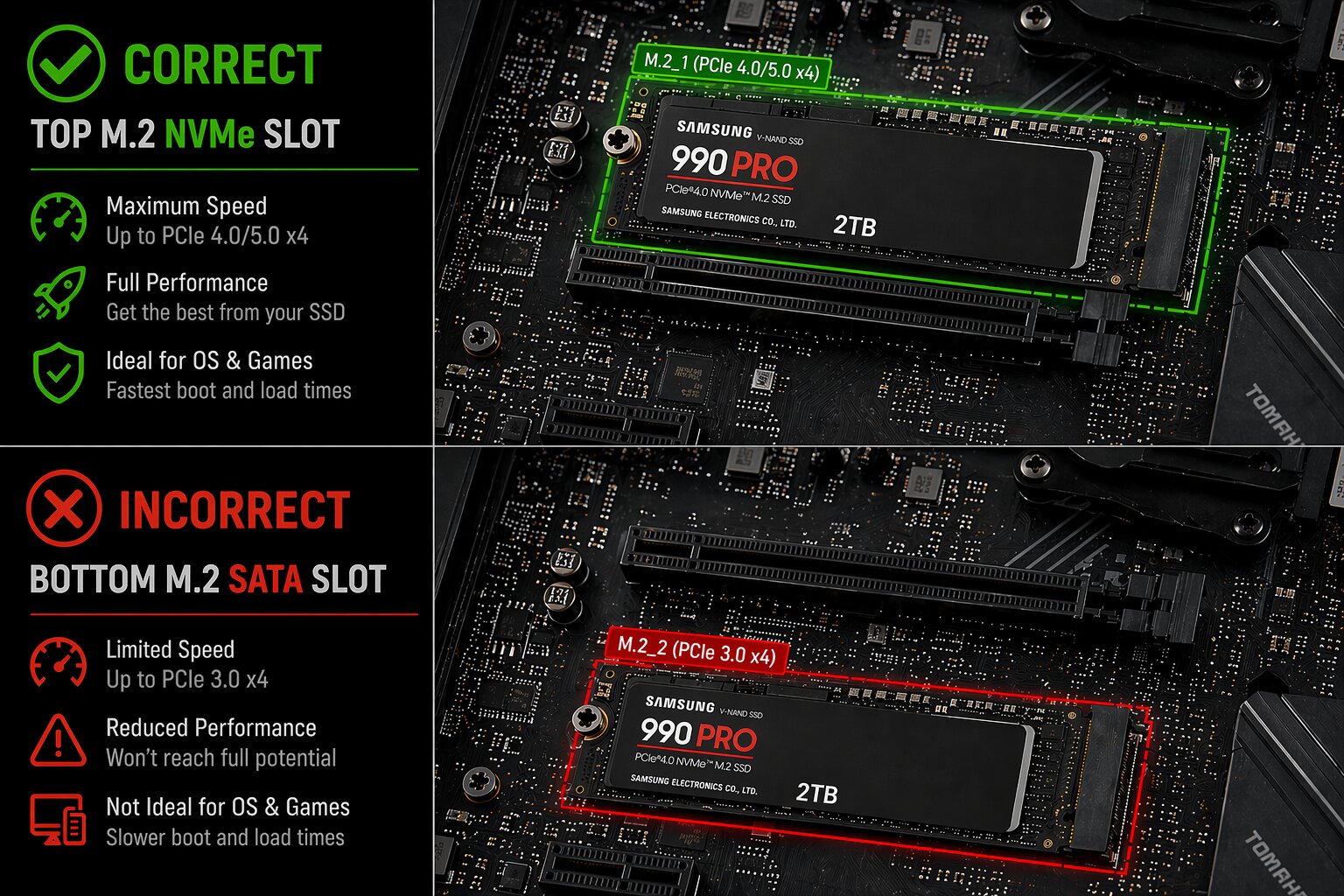
One of the easiest mistakes to make when building or upgrading a PC is assuming that every M.2 slot on the motherboard is essentially the same. After all, they all look nearly identical and use the same “gum-shaped” drive. Motherboard marketing pages like to list “4 x M.2” as if that number alone tells the whole story, but in practice, these slots can behave very differently.
You can get very healthy and luxurious food Non-Volatile Memory Express (NVMe) solid-state drive (SSD) whose performance is far below expectations simply because it is installed in the wrong slot. If you’re shiny new PCI-Express (often shortened to just PCIe) Gen4 or Gen5 If an SSD doesn’t reach advertised speeds, the first thing to check may not be the drive itself, but rather the slot you chose to install it in.
M.2 is a Form Factor, Not a Performance Guarantee
It’s a common trap to assume that “chewing gum” is a shape M.2 drives guarantee a certain level of performance, but in reality M.2 is just a physical form factor. This describes the connector style, not the speed or protocol, which means you might see a Series Advanced Technology Attachments (SATA)drive-based or high-speed NVMe, and the two are often not interchangeable.
Because motherboard manufacturers make their own routing decisions, two slots that look identical can have very different electrical behavior. One may support both SATA and PCIe, while another supports NVMe only. In short: if you want to avoid compatibility issues, checking the motherboard manual is no longer a necessity — it’s very important, because the exact behavior changes depending on which CPU you have installed. For example, let’s consider the following two examples:
- Intel LGA 1700: Mainstream Intel Core CPUs (12th to 14th Generation) typically provide 16 PCIe 5.0 lanes for the graphics card and an additional 4 PCIe 4.0 lanes dedicated to storage, both directly from the CPU. The chipset then adds a larger set of additional PCIe lanes (often PCIe 4.0/3.0, depending on the chipset, such as the Z690/Z790 with up to ~28 lanes), all connected via PCIe 4.0 x4 Direct Multimedia Interface (DMI) connected to the CPU, meaning the paths ultimately share bandwidth.
- AMDAM5: Ryzen 7000/9000 CPUs expose up to 28 PCIe 5.0 lanes, with 24 lanes usable for additional devices (typically 16 for graphics cards + 4 for NVMe + 4 flexible lanes) and 4 reserved for chipset links. Like Intel, the chipset then adds additional PCIe lanes (usually PCIe 4.0/3.0 depending on the B650/X670 tier), connected via a PCIe 4.0 or 5.0 x4 link, meaning devices connected to the chipset share the bandwidth of that uplink.
The essence of the problem is simple: CPU-attached storage is direct, while chipset-attached storage is shared. While the slot connected to the chipset should work fine for everyday use, it will be less than ideal if it shares bandwidth with other devices or disables other features elsewhere on the board.
The Fine Print: Hidden Sacrifice and Disabled Slots
When enthusiasts say “check your motherboard manual”, this is what they mean. You’re not just checking to see if the drive is compatible; You check a few other important things: whether the slot is connected to a CPU, whether it’s running at full x4 bandwidth, what PCIe generations it supports, and whether it ends up sharing lanes with something like your GPU.
The motherboard documentation actually reveals some surprising differences, through the following examples:
- ASUS TUF Gaming Z790-PRO WIFI: This guide shows a non-uniform M.2 layout, including slots that uniquely support PCIe NVMe and SATA SSDs.
- MSI MPG B550 Gaming Plus: This is a classic example of hidden sacrifice. The primary slot comes from the CPU, but if you install a PCIe SSD in the secondary (chipset) M.2_2 slot, then the PCI_E3 expansion slot becomes completely unavailable.
- ES Gigabyte X870E AORUS ELITE WIFI7: The council goes further. The official specifications state that filling the additional M.2 slot connected to the CPU causes the main GPU slot to drop from x16 to x8 operation. Additionally, those additional slots become unavailable altogether if you’re using certain AMD Ryzen 8000 Phoenix processors.

Games vs. Games Content Creation: Does It Matter?
The impact of slot choices is very diverse. For gamersmoving an SSD from one healthy PCIe x4 slot to another usually won’t change the experience. Meanwhile real-world testing from various tech outlets found SSDs to be a big leap forward Hard Disk Drive (HDD)the benefits of switching between faster SSD tiers are often not that great compared to current game load times. However, with Microsoft Direct Storage The API is designed around high-speed PCIe NVMe drives, storage lanes will become more important as games stream assets more aggressively to the GPU.
For content creatorthe “wrong slot” penalty is easier to notice. Workloads such as large file transfers, video editing scratch disks, and media cache management more easily expose storage bottlenecks than gaming. In addition to storage bandwidth, thermal behavior is also critical, as an SSD located in a location with adverse temperatures — such as under a hot GPU or inside a hot chassis — will experience rapid temperature drops during sustained transfers of large amounts of data.

5 Step Slot Sanity Check
To ensure that your storage drive actually performs for the price you paid, use the following checklist:
- Read the storage section in your motherboard manual: Don’t rely on the labels on the board. Identify which slots are connected to the CPU and which are disabled when some of them are used in a certain way.
- Pay attention to the bandwidth distribution: Determine whether your SSD is slowing down the GPU or killing other expansion slots.
- Confirm CPU/platform compatibility: Some M.2 connectors or PCIe revisions may not be available depending on the CPU generation installed on the motherboard in question.
- Run the benchmark: If your performance is seriously out of line with that class of drive, then that’s a red flag for slot, link mode, or potential thermal issues. We recommend Crystal Disk Sign as a great SSD benchmarking tool.
- Monitor thermal: Check temperatures during large transfers to ensure your slot placement isn’t causing performance-killing heat, or that your SSD doesn’t have a properly installed heatsink alongside a quality thermal pad. We recommend HWiNFO as a great program to monitor not only the thermals of your SSD, but also all the relevant components of your PC.

Final Words
M.2 storage is a key component that “looks can be deceiving.” It seems easy until you actually open your motherboard manual. That’s when you realize that one slot may have a direct, high-speed path to the CPU, while the other slot is just an afterthought connected to a chipset that can silently disable your SATA port or change your GPU’s path when you plug it in. Official platform documents from Intel and AMD, along with specific guidance from ASUS, MSI, ASRock, and GIGABYTE, make it clear that not all M.2 connectivity is created equal.
The good news is that these problems are usually easy to fix once you know where to look, but the reality is that most PC makers never bother to check for them. While slot swapping doesn’t always provide a “night and day” performance boost — especially in gaming, where the difference between good NVMe setups is often not that great — poor slot choices can cause very real bottlenecks through path downgrades or bad thermals. Ultimately, your SSD is only as fast and uncompromising as the slot you put it in, which is why this motherboard guide is still one of your most important PC building tools.

About the author: Sebastian Castellanos is a data scientist by education and training. He is also very interested in PC gaming hardware and software. He recently started writing technical articles and Wccftech guides on PC hardware, games, and mods.
Follow Wccftech on Google to get more of our news coverage in your feed.
PakarPBN
A Private Blog Network (PBN) is a collection of websites that are controlled by a single individual or organization and used primarily to build backlinks to a “money site” in order to influence its ranking in search engines such as Google. The core idea behind a PBN is based on the importance of backlinks in Google’s ranking algorithm. Since Google views backlinks as signals of authority and trust, some website owners attempt to artificially create these signals through a controlled network of sites.
In a typical PBN setup, the owner acquires expired or aged domains that already have existing authority, backlinks, and history. These domains are rebuilt with new content and hosted separately, often using different IP addresses, hosting providers, themes, and ownership details to make them appear unrelated. Within the content published on these sites, links are strategically placed that point to the main website the owner wants to rank higher. By doing this, the owner attempts to pass link equity (also known as “link juice”) from the PBN sites to the target website.
The purpose of a PBN is to give the impression that the target website is naturally earning links from multiple independent sources. If done effectively, this can temporarily improve keyword rankings, increase organic visibility, and drive more traffic from search results.
