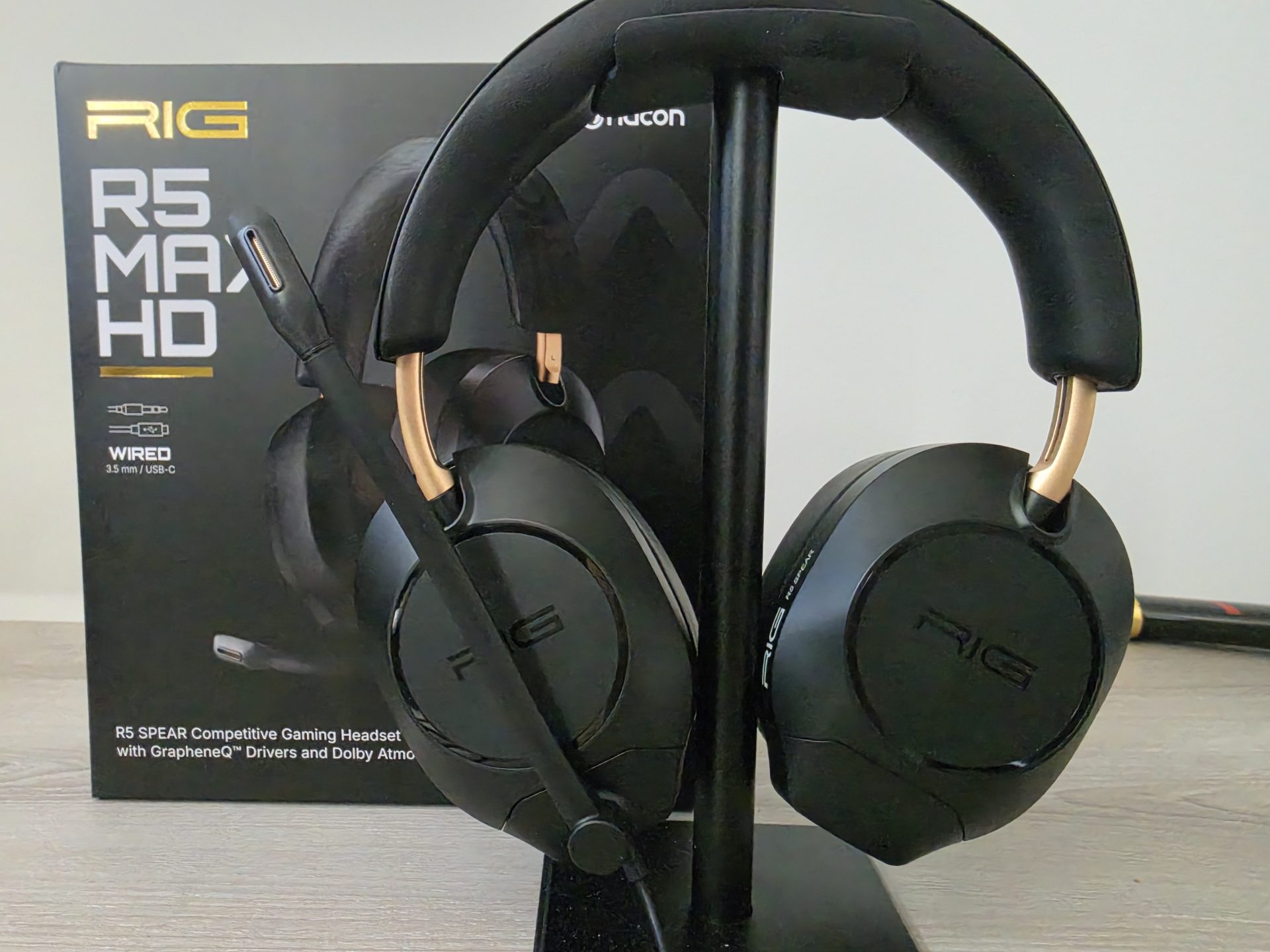
Over the years, my regular set of gaming headsets at the office have been decked out in Razer’s signature green and black, and headsets from Steelseries occasionally stand out among the competition (I use the Arctis Nova Pro Wireless every day for my work, thanks in part to its swappable battery system). What most of these headsets have in common is a wireless form factor that’s easy to transport to the office without leaving a note. It takes something special for me to want to give up the convenience of wireless audio, and I feel like Nacon has really delivered something that will change the game with the RIG R5 MAX HD while also feeling familiar to those who have used their headsets in the past.
Nacon’s RIG line has been around for years and has been known by a few different names over the years but came fully under the Nacon umbrella around 2020, right around the time Plantronics exited the consumer/gaming sector and morphed into Poly to focus on business and enterprise headsets. This helps strengthen RIG’s lineup almost exclusively in gaming for everyone, from kids shopping for a new headset to esports teams competing on the world stage. Whatever your budget, there’s a RIG headset I’m ready to recommend while working at Gamestop, over the Turtle Beach headset, often at twice the price and half the durability.
When Nacon offered me the chance to take a peek at their newest headset, I was curious to see what they meant by wanting to prove they were “built different.” Their newest product, the RIG R5 MAX HD, packs the $70 R5 SPEAR PRO with all its exciting features, along with a more modular design and an external USB-C DAC.

Just as the original RIG R5 headset included in its design, the RIG R5 MAX HD also features the same 40mm graphene drivers (branded GrapheneQ from ORA). Nacon markets these drivers as using >95% pure graphene to help deliver richer audio with less of the distortion you’ll hear from the average driver that muddles the listening experience. The proof is in the listening experience with audio drivers capable of handling a rich soundscape with layered audio that sounds best when run through the DAC making it a complete package. Songs with prominent basslines still have real audio punch without being overpowering or overpowered by the higher ranges. Even with a DAC, you won’t feel the thumping bass or loud booms here that you do on Razer’s Sensa HD range, instead the low end works as it should, thanks in part to Dolby Atmos for Headphones. Hearing gunfire from miles away in Call of Duty Warzone still sounds as it should, and positional audio helps players determine direction even amid communications chatter or background noise.
The included DAC, or Digital-to-Analog Converter, helps the R5 MAX HD produce the best sound on a variety of platforms that can benefit from a wired audio connection. Inside the DAC is an amplifier that helps boost the audio signal with a total power of 30mW at 32 ohms and a sample rate of 32-bit/384kHz. This minuscule four-inch device also features an AUX input to combine with a second source as well as 18W charging passthrough to keep your mobile device running during a six-hour session of Arknights Endfield. USB power is isolated so you won’t notice much of an impact on audio fidelity.

Modular design is what the original RIG R5 series brought with it, and Nacon keeps the simple design intact here with the R5 MAX HD. Everything but the headband itself has a Snap+Lock design, so players get access to swappable earpads, outer plates (Nacon provides a .stl file if you want to 3D print your own pair), and studio cables. There still aren’t many options for players to get replacements directly from Nacon, currently limited to half a dozen designs available in white or black, and one option for replacement earpads. After about a month of regular use, the fabric stitching on the ear cups was starting to show some wear from rubbing against the arms of my glasses, but nothing significant. If nothing else, I’d like to see some sort of cooling gel option that could support glasses wear, like some of its contemporaries on the market offer (of course, the magnetic design here makes it easier to swap components than competitors). There’s also a pair of audio cables that also benefit from a modular design: a 1.5 meter cable with a microphone attachment or a full 2 meter cable if you want to run these headphones without one. Depending on your ideal setup, you can swap the cable between the left and right earcups, and there’s no audio degradation if you prefer one side over the other.
A microphone is a welcome addition to a headset, as I’m sure most gamers wouldn’t want to buy a set of headphones that didn’t include one in the package. With a unidirectional design and a claimed frequency response of 50 Hz – 15 kHz, this is one of the more average additions to the package. Firstly, it’s very quiet, even when cranked up to the highest setting, and I’ve often been told that it’s a bit tinny when used for telecommunications. If you have the means in your setup, I recommend sticking with a 2 meter cable here and leaving the audio input to a standalone microphone if you want to maximize audio fidelity.

To get the most out of the Nacon R5 MAX HD, you’ll want to run it on a platform that fully supports USB-C audio, and preferably, a Windows machine to get access to Dolby Atmos. For mobile use, of course you’ll want to take advantage of the USB-C DAC as almost every other phone maker has abandoned the 3.5mm headphone jack unless you’re REDMAGIC. Eliminating the DAC turns these headphones into just an average set of headphones with layered, isolated-feeling audio tracks and crisp piano highs instead of simply blending in with the warmth of the audio, as I noticed when listening to one of my favorite albums of all time.
For a complete package, the RIG R5 MAX HD from Nacon takes an average $70 headset and upgrades it with an updated modular design and external audio DAC to really get the most out of the GrapheneQ drivers. While the package itself is more than double the price of the R5 Spear Pro, what you’re offered here is something that elevates a cheap headset into something you’ll want to achieve over your wireless headset.

[Editor’s Note: The Nacon RIG R5 MAX HD Wired Headset was provided by the hardware manufacturer for editorial purposes.]
You can find additional information about our hardware review process and ethics policy here.

8.0
WCCFTECH RATINGS
The RIG R5 MAX HD is built for high-fidelity gaming on the competitive circuit, featuring a new modular design that takes center stage and an external audio DAC that helps get the most out of the GrapheneQ drivers.
- Modular Snap+Lock design to swap cable placement, remove microphone when not needed, as well as ear cups and pads
- External audio DAC with 18w power passthrough without breaking the bank
- Excellent for gaming on Windows with full Dolby Atmos support for Headphones
- Graphene audio drivers fit the budget
- 3D printable files are available if you want to design your own earplugs
Excess
- The headset is just a regular RIG R5 Spear Pro with a cable that can be removed when the DAC is not in use
- The material on the earcups wears unevenly, especially for glasses wearers
- The microphone is mediocre and I often use longer cables without it
- The head pad cannot be replaced once it has been used
- Limited selection of SNAP+LOCK accessories even direct from Nacon
Counter
Buy from Amazon
The links above are affiliate links. As an Amazon Associate, Wccftech.com may earn from qualifying purchases.
PakarPBN
A Private Blog Network (PBN) is a collection of websites that are controlled by a single individual or organization and used primarily to build backlinks to a “money site” in order to influence its ranking in search engines such as Google. The core idea behind a PBN is based on the importance of backlinks in Google’s ranking algorithm. Since Google views backlinks as signals of authority and trust, some website owners attempt to artificially create these signals through a controlled network of sites.
In a typical PBN setup, the owner acquires expired or aged domains that already have existing authority, backlinks, and history. These domains are rebuilt with new content and hosted separately, often using different IP addresses, hosting providers, themes, and ownership details to make them appear unrelated. Within the content published on these sites, links are strategically placed that point to the main website the owner wants to rank higher. By doing this, the owner attempts to pass link equity (also known as “link juice”) from the PBN sites to the target website.
The purpose of a PBN is to give the impression that the target website is naturally earning links from multiple independent sources. If done effectively, this can temporarily improve keyword rankings, increase organic visibility, and drive more traffic from search results.