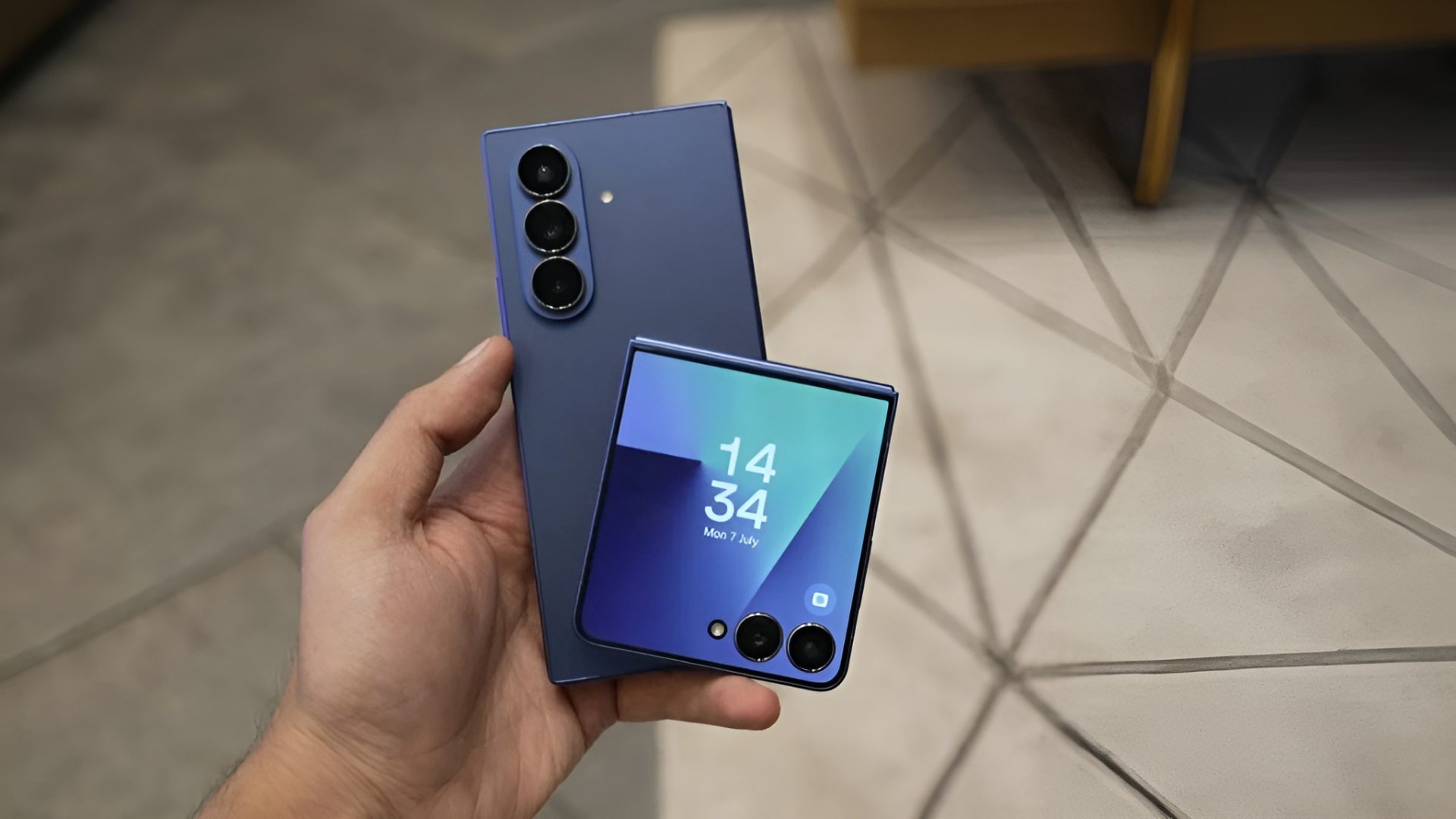
Samsung is not expected to fundamentally change its current pattern when it launches the Galaxy Z Flip 8 later this summer. Even so, the South Korean tech giant is considering several iterative improvements that will likely improve the ergonomics and aesthetics of the device.
The Samsung Galaxy Z Flip 8 will weigh 8 grams less than the Flip 7, and feature a new hinge and a crease-free screen.
South Korea-based Yeux1122 has now published a new blog post, detailing that the Galaxy Z Flip 8 will be about 0.5 mm slimmer than the Flip 7, thanks to a new hinge mechanism.
This is in line with the latest CAD renders published by OnLeaks and Android Headlines, which show the device measuring 166.8 mm x 75.4 mm x 6.6 mm when unfolded and 85.4 mm x 75.4 mm x 13.2 mm when folded, which suggests that the Flip 8 is only about half a millimeter thinner when folded than the Flip 7.
Elsewhere, Yeux1122 detailed that the upcoming foldable device will weigh around 8 grams less than the Flip 7, largely due to the new hinge mechanism.
Most importantly, the Galaxy Z Flip 8 is now expected to come with a crease-free folding display. Of course, given the exciting information about the improved hinge, it’s likely that this innovation will play a big role in eliminating the dreaded crease that has plagued all Samsung foldable devices to date.
Lastly, the Galaxy Z Flip 8 is expected to retain the Flip 7’s camera module, battery capacity and charging speed.
We already know from previous information that the foldable device will feature a 4.1-inch cover display and a 6.9-inch inner screen that appears to be an exact replica of the Flip 7, equipped with dual rear cameras and an LED flash on the cover panel.
Note that Samsung is apparently preparing to produce 3.5 million units of the Galaxy Z Fold 8 and between 2.5 million to 3 million units of the Galaxy Z Flip 8 ahead of its planned launch in the second half of 2026. Importantly, this is the first time that Z Fold units will surpass their Flip counterparts in the South Korean tech giant’s annual production cadence.
Until last year, Z Flip devices accounted for around 60 to 70 percent of Samsung’s foldable device sales volume in a given year. However, this sales mix changes in 2025 with the Galaxy Z Fold 7, which is lighter than the Galaxy S25 Ultra, has a thickness of only 8.9 mm, and manages to outperform the Flip 7 in sales.
Follow Wccftech on Google to get more of our news coverage in your feed.
PakarPBN
A Private Blog Network (PBN) is a collection of websites that are controlled by a single individual or organization and used primarily to build backlinks to a “money site” in order to influence its ranking in search engines such as Google. The core idea behind a PBN is based on the importance of backlinks in Google’s ranking algorithm. Since Google views backlinks as signals of authority and trust, some website owners attempt to artificially create these signals through a controlled network of sites.
In a typical PBN setup, the owner acquires expired or aged domains that already have existing authority, backlinks, and history. These domains are rebuilt with new content and hosted separately, often using different IP addresses, hosting providers, themes, and ownership details to make them appear unrelated. Within the content published on these sites, links are strategically placed that point to the main website the owner wants to rank higher. By doing this, the owner attempts to pass link equity (also known as “link juice”) from the PBN sites to the target website.
The purpose of a PBN is to give the impression that the target website is naturally earning links from multiple independent sources. If done effectively, this can temporarily improve keyword rankings, increase organic visibility, and drive more traffic from search results.
