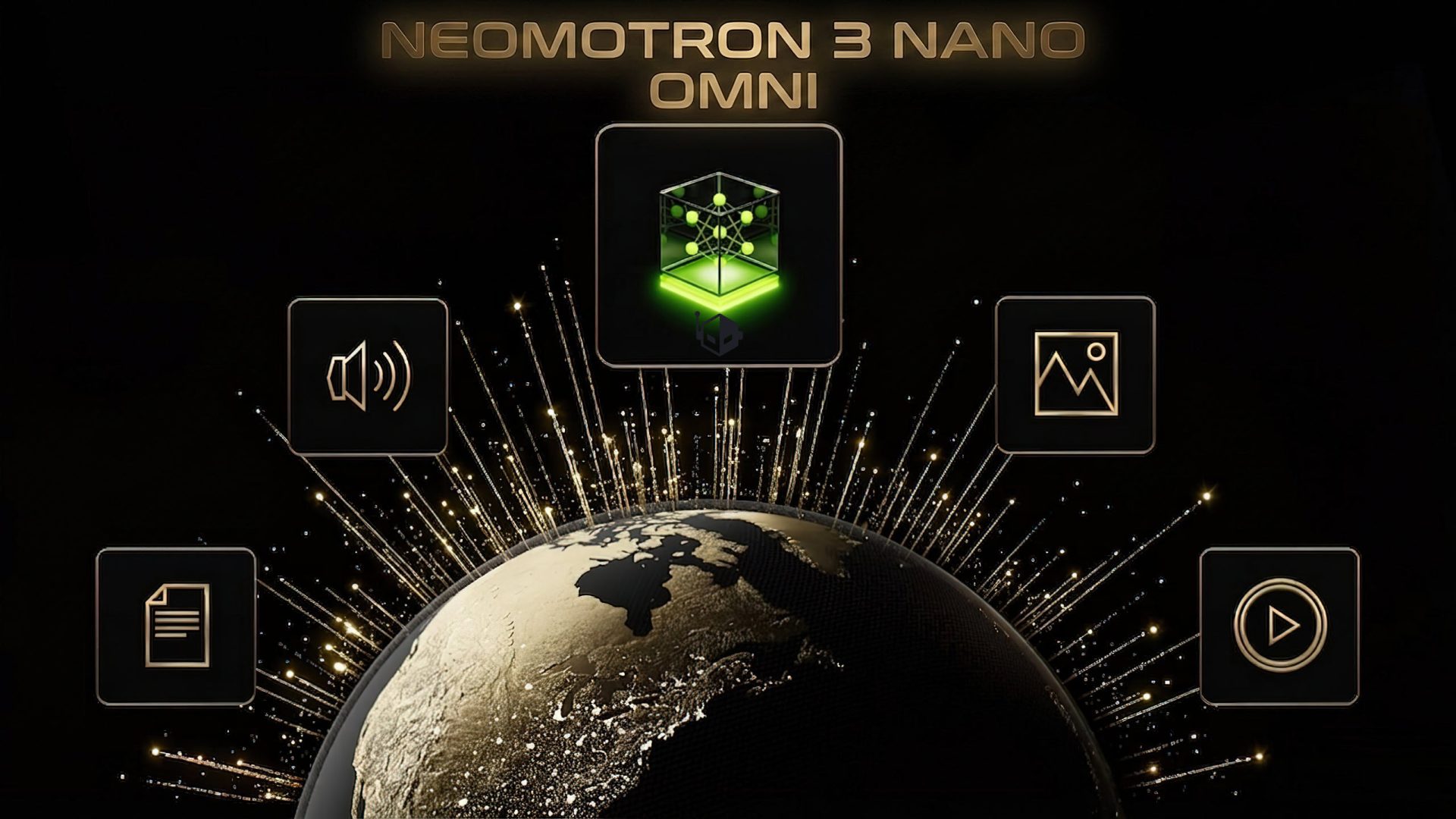
NVIDIA has introduced its newest Open AI Model, the Neomotron 3 Nano Omni, which offers 9x faster Agentic AI throughput.
NVIDIA’s Open AI Model Expansion Continues With Neomotron 3 Nano Omni Delivering 9x Improvements
Press Release: Launched today, NVIDIA Nemotron 3 Nano Omni is an open, multimodal model that unifies these capabilities into one system, enabling agents to provide faster, smarter responses with advanced reasoning across video, audio, images, and text. This best-in-class model provides companies and developers with a production pathway for more efficient and accurate multimodal AI agents with full deployment flexibility and control.
Nemotron 3 Nano Omni sets new efficiency frontiers for open multimodal models with leading accuracy and low cost, topping six leaderboards for complex document intelligence, and video and audio understanding.
AI and software companies that have adopted the Nemotron 3 Nano Omni include Aible, Applied Scientific Intelligence (ASI), Eka Care, Foxconn, H Company, Palantir, and Pyler, with Dell Technologies, DocuSign, Infosys, K-Dense, Lila, Oracle, and Zefr evaluating the model.
Nemotron 3 Nano Omni Enables Faster, Leaner Multimodal Agents
By combining vision and audio encoders in the 30B-A3B, hybrid master mix architecture, the Nemotron 3 Nano Omni eliminates the need for separate perception models, thereby driving inference efficiency at scale. The model combines this efficiency with strong multimodal perception accuracy, enabling the AI system to achieve 9x higher throughput than other open omni models with the same interactivity. The result is lower costs and better scalability without sacrificing responsiveness or quality.
In agent systems, Nemotron 3 Nano Omni can work alongside other NVIDIA Nemotron proprietary cloud models or open models — such as Nemotron 3 Super for high-frequency execution or Nemotron 3 Ultra for complex planning — as well as proprietary models from other providers, to support sub-agents for agent workflows such as computer use, document intelligence, and audio-video reasoning.
- Computer use agent — Nemotron 3 Nano Omni amplifies the perception loop for agents navigating graphical user interfaces, thinking about on-screen content, and understanding the state of the user interface over time. H Company’s latest computer usage agent, powered by Nemotron 3 Nano Omni, uses a native input resolution of 1920×1080 pixels to achieve high-fidelity visual reasoning. In initial evaluations on OSWorld benchmarks, this integration demonstrated a significant leap in navigating complex graphical interfaces and utilizing the Nemotron 3 Nano Omni’s capabilities for processing ultra-high resolution images.
- Document intelligence — Interpret documents, charts, tables, screenshots, and mixed media input, enabling agents to consider visual structure and text content coherently. Critical for enterprise analytics and compliance workflows.
- Audio and video understanding — For customer service, research, and monitoring workflows, the Nemotron 3 Nano Omni maintains audio-video context, tying what is said, shown, and documented into one stream of thought, rather than a disconnected summary.

About the author: A Software Engineer by training and PC enthusiast by passion, Hassan Mujtaba serves as Wccftech’s Senior Editor for the hardware section. With years of experience in the industry, he specializes in in-depth technical analysis of next-generation CPU and GPU architectures, motherboards, and cooling solutions. His work includes not only the latest news on upcoming technologies, but also extensive hands-on reviews and benchmarks.
Follow Wccftech on Google to get more of our news coverage in your feed.
PakarPBN
A Private Blog Network (PBN) is a collection of websites that are controlled by a single individual or organization and used primarily to build backlinks to a “money site” in order to influence its ranking in search engines such as Google. The core idea behind a PBN is based on the importance of backlinks in Google’s ranking algorithm. Since Google views backlinks as signals of authority and trust, some website owners attempt to artificially create these signals through a controlled network of sites.
In a typical PBN setup, the owner acquires expired or aged domains that already have existing authority, backlinks, and history. These domains are rebuilt with new content and hosted separately, often using different IP addresses, hosting providers, themes, and ownership details to make them appear unrelated. Within the content published on these sites, links are strategically placed that point to the main website the owner wants to rank higher. By doing this, the owner attempts to pass link equity (also known as “link juice”) from the PBN sites to the target website.
The purpose of a PBN is to give the impression that the target website is naturally earning links from multiple independent sources. If done effectively, this can temporarily improve keyword rankings, increase organic visibility, and drive more traffic from search results.
